

Michael Julian
Second Generation CEO
The legal frameworks surrounding strikes and labor disputes play an integral role in defining the parameters within which employers, employees, and unions can operate. They ensure a balance between the interests of all stakeholders and form a crucial cornerstone in maintaining industrial harmony.
The evolution of labor laws has been a dynamic process, shaped by social, economic, and political contexts. From their rudimentary beginnings in the 19th century, as a response to the harsh working conditions of the industrial revolution, labor laws have progressively become more comprehensive and sophisticated. The journey of these laws represents a gradual shift from a laissez-faire attitude towards a more interventionist approach that strives to protect workers' rights and ensure fair working conditions¹.
There have been several key turning points in the evolution of labor laws. The introduction of the Factory Acts in the United Kingdom during the 19th century marked a significant early development in legislating working conditions². In the United States, the passing of the Wagner Act or the National Labor Relations Act in 1935, which guaranteed basic rights of private sector employees to organize into trade unions, was a landmark event³. Over time, legislation has expanded to cover issues like minimum wages, working hours, safety standards, and anti-discrimination laws, representing the evolving societal understanding of workers' rights.
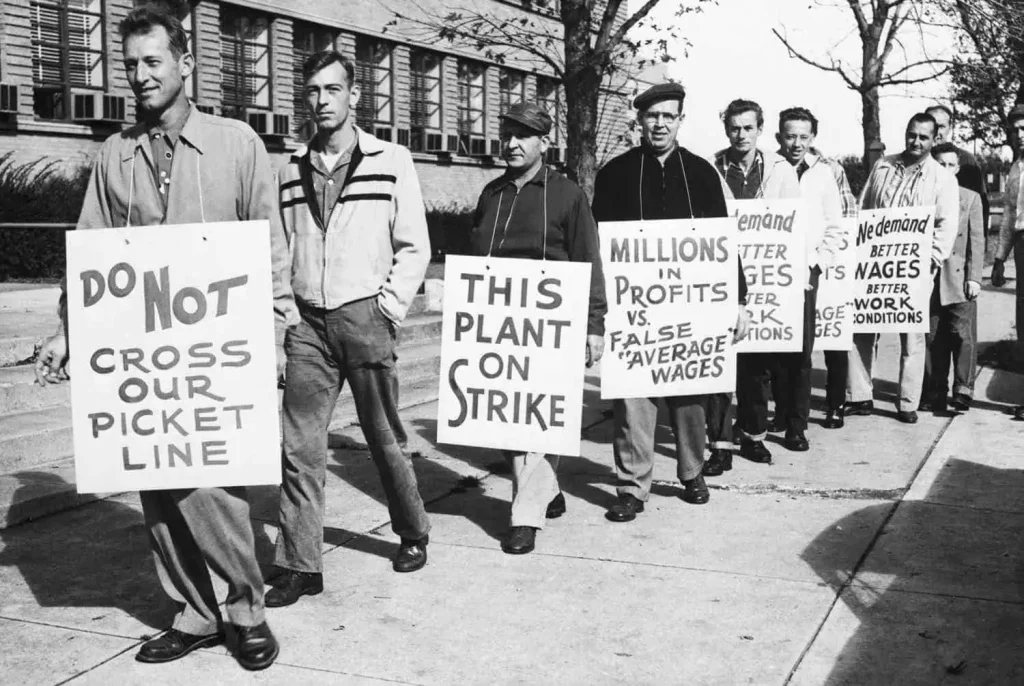
The landscape of labor laws and strike regulations varies considerably across countries, reflecting the unique social, political, and economic contexts of each nation. In the United States, the right to strike is protected by the National Labor Relations Act, but restrictions apply, particularly for public sector employees⁴. In contrast, countries like France have more worker-friendly laws, allowing strikes over a wide range of issues, beyond the immediate realm of employment conditions⁵. This spectrum of national legislation underscores the diversity of approaches in managing industrial relations and labor disputes.
At the international level, bodies like the International Labor Organization (ILO) play a crucial role in setting labor standards. Established in 1919, the ILO brings together representatives of governments, employers, and workers to formulate conventions and recommendations that aim to promote fair labor practices and decent work across the globe⁶.
The standards set by the ILO often serve as a blueprint for nations to shape their labor legislation. For instance, the ILO's Convention No. 87 concerning Freedom of Association and Protection of the Right to Organize and Convention No. 98 concerning the Application of the Principles of the Right to Organize and to Bargain Collectively have provided a foundation for many nations in framing their labor laws and regulations⁷. These international standards have proven instrumental in promoting workers' rights and guiding the development of more equitable labor laws globally.
The right to strike, while recognized globally as a fundamental labor right, varies significantly in its legal standing across jurisdictions. In the United States, the right to strike is generally protected for private-sector workers under the National Labor Relations Act. However, different rules apply to public-sector employees, who may be restricted from striking, especially if they perform essential services¹. European countries like Germany and France grant robust strike rights, including the right to strike for political and solidarity reasons². In contrast, some countries have stringent restrictions on the right to strike, especially for public sector workers or those in essential services.
Balancing the right to strike with other societal needs is a complex task. On the one hand, the right to strike is seen as a fundamental labor right and an essential tool for workers to express grievances and bargain collectively. On the other hand, strikes can disrupt essential services and affect the broader economy³. Laws often strive to strike a balance, allowing for strikes but imposing certain conditions or restrictions to minimize potential societal disruptions.
Employers have several legal obligations during strikes and labor disputes. For instance, they cannot terminate employees simply for participating in a lawful strike⁴. Additionally, after the conclusion of a strike, employers are usually required to reinstate striking employees⁵.
Employer rights during strikes are subject to certain limitations. While employers can continue operations during a strike by using non-striking employees or hiring replacements, they cannot engage in unfair labor practices such as threatening workers or interfering with their right to strike⁶. These rules are designed to prevent coercive tactics that might undermine the right to collective bargaining.
Workers participating in a legal strike are protected from employer retaliation⁷. They cannot be lawfully fired for engaging in strike activities. However, striking workers have responsibilities too. They must observe picketing rules and cannot engage in violent or coercive behavior during the strike⁸.
If workers believe their rights have been violated during a strike, they have legal recourse. In the US, for instance, they can file a complaint with the National Labor Relations Board, which can investigate allegations of unfair labor practices⁹.
Unions play a pivotal role in labor disputes, representing the collective interests of workers. Legally, unions are recognized entities with the right to negotiate with employers on behalf of their members. They can call for strikes, organize picket lines, and engage in other collective actions to express worker grievances and demand better terms of employment¹⁰.
Unions utilize various strategies and tactics within the legal framework to achieve their objectives. These range from negotiation and mediation to calling for strikes. Unions are also involved in the legal processes surrounding labor disputes, including filing unfair labor practice charges or representing workers in arbitration proceedings. However, they must operate within the confines of labor laws, which set rules for union activities and the conduct of strikes¹¹.
Labor disputes, including strikes, are often resolved through legal processes. These processes typically involve negotiation between the disputing parties, possibly with the assistance of a mediator. If a resolution cannot be reached through negotiation, the dispute may be taken to arbitration or litigation¹. In some jurisdictions, labor disputes must go through mandatory mediation before they can be taken to court².
Mediation and arbitration play critical roles in resolving labor disputes. Mediation involves a neutral third party facilitating negotiations between the disputing parties to help them reach a mutually satisfactory agreement³. If mediation fails, disputes can go to arbitration, where an arbitrator or an arbitration panel hears the case and makes a binding decision⁴. Arbitration is generally faster and less formal than court litigation.
Many significant strikes and labor disputes have had important legal implications. For instance, the Air Traffic Controllers strike in 1981 in the United States led to a landmark decision that affirmed the government's right to fire striking employees if they perform essential services⁵. The Miners' Strike in the UK in 1984-85 led to significant changes in labor laws and a shift in the balance of power between unions and employers⁶.
These and other labor disputes have highlighted the importance of clear and fair labor laws. They have led to legislative changes aimed at protecting worker rights, ensuring fair negotiations, and maintaining public safety and order during strikes.
Given current socio-economic trends, labor laws and regulations are likely to continue evolving. The rise of the gig economy, the increasing prevalence of remote work, and the growing importance of worker rights in the public discourse are all factors that may lead to changes in labor laws. For instance, laws may need to adapt to better protect gig workers, who often lack the same rights and protections as traditional employees⁷.
Technology and the changing nature of work are also impacting labor laws. The rise of automation and AI, for example, is raising questions about job security and workers' rights in an increasingly automated economy⁸. Labor laws will need to address these new challenges to ensure that workers are protected in the future of work.
This article has explored the legal framework of strikes and labor disputes, from the historical evolution of labor laws to current legislation and international standards. We examined the legal rights and responsibilities of employers and workers, the role of unions, the process of dispute resolution, and the legal implications of notable labor disputes. We also discussed potential future developments in labor laws in light of technological and socio-economic trends.
Understanding the legal framework is crucial for both employers and workers involved in strikes and labor disputes. It helps them navigate the process, protects their rights, and informs their strategies and decisions. As labor laws continue to evolve, staying informed about the legal landscape will remain vital for all parties involved in labor relations.
Michael D. Julian is President of MPS Security & Protection and a 30-plus-year veteran of the security and investigations industry. He served as President of the California Association of Licensed Investigators (CALI) from 2005 to 2015 and has led executive protection, residential security, and corporate investigations engagements for Fortune 500 principals, high-net-worth families, and public figures across the United States. Connect with Michael on LinkedIn.

Since 1967, MPS Security & Protection has delivered professional protective security grounded in respect, coordination, and discretion. We’re a 3rd-generation firm with longstanding client relationships and worldwide connections.
“No two clients are the same, and neither are their needs. We protect what matters most, so you don't have to.” — Our protection is tailored to your risks, lifestyle, and operations.


Experts in Executive Protection and Uniformed Security.
Second Generation CEO

President

Executive Protection Manager

Uniform Security Manager
RST teams safeguard homes and families with 24/7 protection and low-profile coverage.
We’re always looking for professional Executive Protection Agents and Uniformed Security Officers. Apply through our portal.
Let’s discuss your needs and design a protection plan that fits your risk profile.
The greatest threat to a protected client is often medical, not criminal. Learn how professional executive protection teams build medical preparedness… By: Michael D. Julian Counter-surveillance is how executive protection teams spot people watching a principal before an attack. Here is how it works and why it matters in 2… By: Michael D. Julian The work that prevents an incident usually happens before the principal arrives. Here is what an executive protection advance team does to survey a ve… By: Michael D. Julian Ground transportation is the highest-risk phase of an executive's day. Here is how professional protection teams plan vehicles, routes, and trained dr… By: Michael D. Julian Protective intelligence is how executive protection teams find and assess threats before they materialize. Here is what it covers, why it matters, and… By: Michael D. Julian How professional executive protection teams plan annual shareholder meetings and investor days, from advance work and venue security to activist expos… By: Michael D. Julian How family offices structure executive protection across principals, spouses, and adult children in 2026 â€" including covert posture, residential cov… By: Michael D. Julian How corporate threat assessment teams bring HR, Legal, and Security together to identify, evaluate, and manage individuals of concern before incidents… By: Michael D. JulianRecent MPS Security Insights

Medical Preparedness in Executive Protection: Why Every Detail Needs an Emergency Action Plan
Counter-Surveillance In Executive Protection
What an Executive Protection Advance Team Actually Does: How Venues Are Surveyed Before the Principal Arrives
Secure Transportation for Executives: How Protection Teams Plan Vehicles, Routes, and Drivers
Protective Intelligence: How Executive Protection Teams Identify Threats Before They Reach the Principal
Executive Protection at Annual Shareholder Meetings and Investor Days: How Public-Company Boards Plan for Activist and Threat Exposure
Executive Protection for Family Offices: A 2026 Guide to Protecting Principals, Spouses, and Adult Children
Workplace Threat Assessment Teams: How HR, Legal, and Security Should Collaborate to Prevent Targeted Violence